

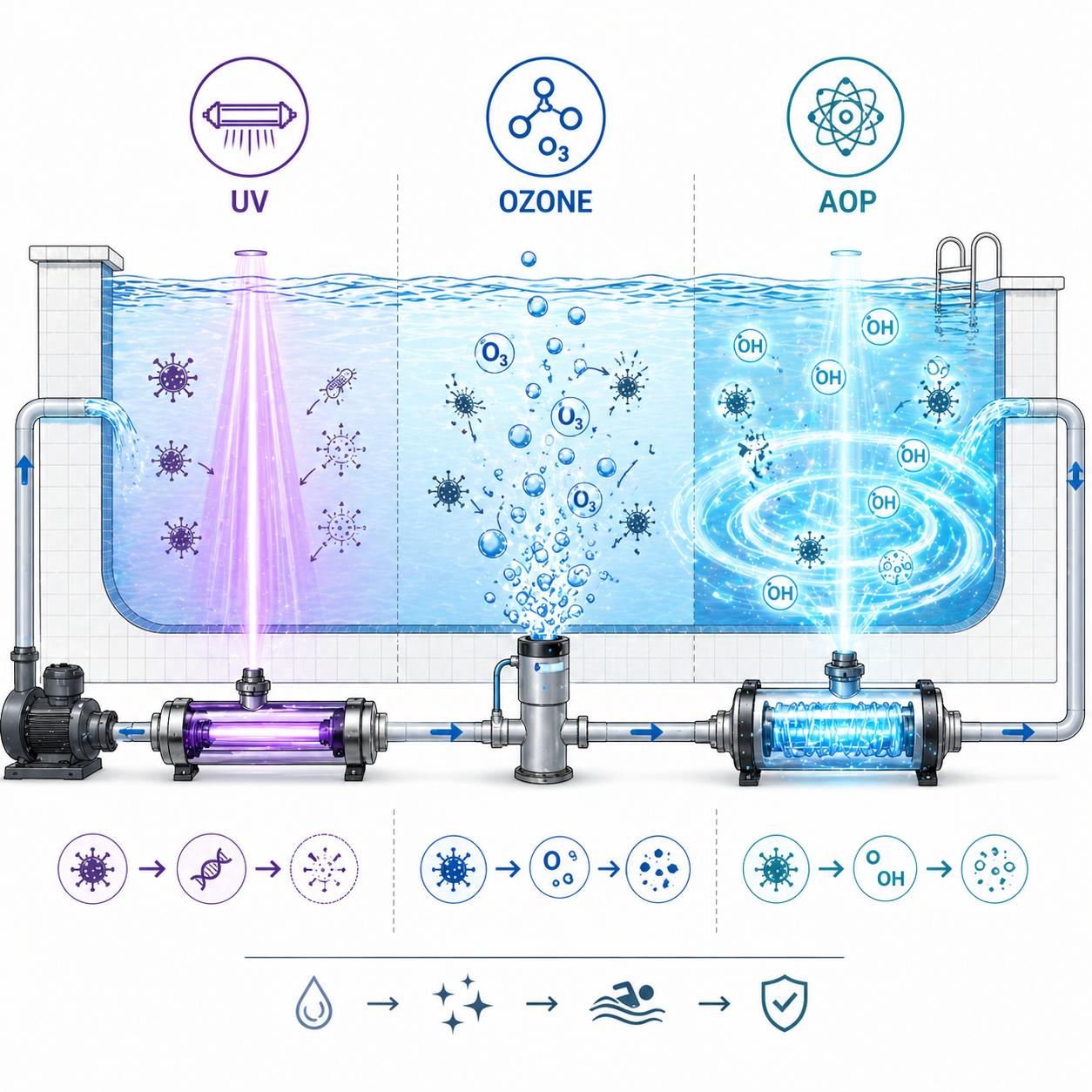
AOP vs. UV vs. Ozone: The Best Sanitation System for Your Pool
When selecting an advanced water treatment system for your pool, the best choice for achieving the clearest, safest, and most comfortable water with the lowest possible chlorine levels is an AOP pool system. While some systems create an Advanced Oxidation Process (AOP) by combining UV light and Ozone, patented, next-generation AOP systems use a more advanced method. They work by treating air to produce atomic oxygen, which, when injected into the pool's water, creates hydroxyl radicals—the most potent sanitizing agents available for residential pools. This modern approach offers a comprehensive solution by both inactivating pathogens like Cryptosporidium and actively destroying organic contaminants, oils, and lotions. This powerful action dramatically reduces chloramine formation, eliminates the harsh chlorine smell, and delivers a superior swimming experience without the need for UV bulbs.
Key Takeaways
- AOP (Advanced Oxidation Process): The most powerful and complete system. Modern, patented AOP systems use atomic oxygen to create hydroxyl radicals, which actively destroy a wide range of contaminants. This provides the most effective path to a low-chlorine pool and is a distinct alternative to UV and Ozone systems.
- UV (Ultraviolet) Sanitizer: Highly effective at inactivating waterborne pathogens, including chlorine-resistant bacteria and viruses, as they pass through the unit. However, UV does not oxidize waste or provide a sanitizing residual in the pool.
- Ozone Generator: A potent oxidizer that breaks down organic waste, lotions, and oils on contact, effectively reducing chloramines. Its sanitizing effect is immediate but short-lived and confined to the point of injection.
- The True Goal: All three are secondary or supplemental sanitizers. They work with a low level of chlorine (0.5-1.0 ppm) to ensure the entire body of water remains safe, not to eliminate chlorine completely.
- Best for Superior Water Quality: AOP is the definitive choice for superior water quality. While UV or Ozone units offer targeted benefits over a chlorine-only pool, they represent an incomplete solution. Only AOP provides a comprehensive, powerful treatment that handles both sanitization (killing germs) and oxidation—the breakdown of irritating contaminants like oils and chloramines—making it the truly best-in-class system.
Why Look Beyond a Chlorine-Only Pool?
For decades, chlorine has been the default sanitizer for backyard pools. It’s effective and affordable, but its drawbacks are well-known. When chlorine interacts with organic matter from swimmers—like sweat, oils, and cosmetics—it forms combined chlorine, or chloramines. These are the real culprits behind the notorious "chlorine smell," red eyes, dry skin, and faded swimwear.
To combat chloramines, owners often have to "shock" the pool with a massive dose of chlorine, leading to a cycle of chemical spikes and dips. The goal of a modern low chlorine pool system is to break this cycle. By using advanced technology—whether it's an AOP, UV, or Ozone system, or other popular alternative sanitizers like Salt Chlorinators and Pool Mineral Purifiers—to do the heavy lifting of sanitizing and oxidizing, you can maintain a minimal, barely noticeable level of chlorine (0.5-1.0 ppm) simply as a residual safeguard, ensuring the water remains protected from contamination.
Deconstructing the Contenders: UV vs. Ozone vs. AOP
Understanding the science behind each of these alternative pool sanitation systems is key to appreciating their distinct roles. While this comparison focuses on AOP, UV, and Ozone, it's helpful to know they are part of a broader family of solutions that also includes Salt Chlorinators and Mineral Purifiers. The systems we're deconstructing here—AOP, UV, and Ozone—are often chosen for their powerful, targeted approach to water treatment. They are not interchangeable; each targets different problems with different mechanisms.
How a UV Pool Sanitizer Works
A UV sanitizer is an in-line system that houses a powerful ultraviolet lamp. As your pump circulates water, it flows through the UV chamber, where it is exposed to a specific wavelength of UV-C light (around 254 nanometers). This light is germicidal, meaning it penetrates the cell walls of microorganisms like bacteria, viruses, algae spores, and protozoa (including the highly chlorine-resistant Cryptosporidium and Giardia) and scrambles their DNA. This renders them unable to reproduce and harmless.
Think of it as a targeted sterilization process. It's incredibly effective at what it does, but its action is limited to the water currently passing through the unit.
- Pros: Excellent at inactivating pathogens, no chemicals added, reduces the amount of chlorine needed for primary sanitization.
- Cons: Provides no oxidation—it won’t break down non-living organic compounds like suntan lotion or body oils. It also leaves no residual sanitizer in the pool; water can become contaminated the moment it leaves the return jet.
How an Ozone Generator Works
Ozone (O3) is a powerful, naturally occurring oxidizer. An ozone generator for a pool typically uses a Corona Discharge (CD) unit to pass air through a high-voltage electrical field, splitting oxygen molecules (O2) apart. These individual atoms then re-form as ozone (O3). This unstable O3 is then injected into the pool's plumbing, usually via a venturi injector that creates suction.
Once in the water, ozone immediately attacks and destroys organic and inorganic matter through oxidation—essentially "burning up" contaminants like cosmetics, body oils, and the precursors to chloramines. This is a highly effective purification process.
- Pros: One of the strongest oxidizers available, drastically reduces the formation of irritating chloramines, and helps improve water clarity by breaking down organic waste.
- Cons: Ozone has a very short half-life (it works fast and disappears quickly). It provides almost no lasting residual sanitization in the main body of the pool. The sanitizing action is intense but highly localized to the plumbing system.
What is an AOP Pool System and Why is it the Gold Standard?
An Advanced Oxidation Process (AOP) creates powerful hydroxyl radicals (•OH) to provide the ultimate in water sanitation. However, not all AOP systems are the same. While older methods combine UV light and Ozone to produce these radicals, a more advanced, patented type of AOP pool system functions as a superior alternative to UV and Ozone entirely.
This next-generation AOP technology works by pulling in ambient air and passing it through a patented cell that produces atomic oxygen. This treated air is then safely injected into the pool's plumbing. When the atomic oxygen comes into contact with the water, it instantly creates a high concentration of hydroxyl radicals. These are the most powerful oxidizers that can be safely used in a pool, reacting immediately to destroy contaminants with significantly more potency and speed than ozone or chlorine alone.
This direct-injection AOP system delivers a powerful, two-step sanitizing punch:
- Atomic Oxygen Production: The system's core cell safely produces energized, single oxygen atoms from the air.
- Hydroxyl Radical Formation: These atoms react with water (H2O) to form a cloud of powerful hydroxyl radicals (•OH) that instantly destroy bacteria, viruses, and stubborn organic contaminants.
- Pros: The most powerful and comprehensive water treatment available. Directly creates the strongest sanitizing agents for water. Results in exceptionally clear, fresh-feeling water with the lowest possible chemical demand. Does not require annual UV bulb replacements.
- Cons: While it drastically reduces the need for chemicals, it works alongside a low-level chlorine residual (0.5-1.0 ppm) to ensure the water remains protected at all times—a fundamental requirement it shares with both UV and Ozone systems.
Direct Comparison: Which System is Best for Your Specific Needs?
Choosing between a UV pool sanitizer vs ozone vs AOP depends on your primary goals and budget. Here’s a practical breakdown for pool owners.
For Maximum Pathogen Destruction: AOP > UV > Ozone
While all three systems are effective, AOP provides the most complete kill. Hydroxyl radicals are the most powerful oxidizing agents available in pool care, providing an unmatched level of destruction against a wide range of contaminants. A standalone UV system is a close second and is exceptionally good at targeting chlorine-resistant microorganisms.
For Eliminating Chloramines and "Pool Smell": AOP > Ozone > UV
This is where oxidizing power matters. AOP systems are the undisputed champions at destroying chloramines, leading to water that feels and smells exceptionally fresh. Ozone is also a very strong oxidizer and is highly effective at this task. UV, lacking any oxidation capability, does not directly break down chloramines, though it can prevent their formation by reducing the overall microbial load.
For Achieving the Lowest Chlorine Levels: AOP
Because an AOP system handles both sanitization (inactivating germs) and oxidation (destroying waste) so effectively, it reduces the workload on chlorine more than any other system. This allows you to comfortably and safely maintain a free chlorine level of 0.5-1.0 ppm, which is comparable to drinking water standards. With UV or Ozone, you might need a slightly higher residual (1.0 ppm) to handle the tasks the system doesn't cover.
Beyond Upfront Cost: The Smartest Long-Term Investment
While some UV or Ozone systems may appear to have a lower upfront price, a savvy pool owner must consider the total cost of ownership, including maintenance, operating expenses, and chemical savings. This is where advanced AOP systems demonstrate their superior value. A next-generation AOP system is a smarter investment because it lowers operating costs by 60% or more and requires up to 90% less maintenance than UV systems that need annual bulb replacements. Furthermore, by creating more powerful hydroxyl radicals for faster sanitation, AOP provides better water and air quality by reducing 70% more disinfection byproducts (chloramines) and lowering overall chlorine demand by 30% to 70%. For these reasons, AOP isn't just the most powerful option—it's the most cost-effective and intelligent choice over the life of your pool.
Common Mistakes to Avoid When Choosing an Alternative Pool Sanitation System
Investing in advanced technology can be a waste of money if not implemented correctly. Here are the most critical mistakes we see pool owners make.
Mistake #1: Believing You Can Go "Chlorine-Free"
This is the most dangerous misconception. UV, Ozone, and AOP systems treat the water as it passes through your plumbing. They do not create a lasting sanitizer "residual" in the pool itself. Without a low level of an EPA-approved sanitizer like chlorine or bromine in the water, there is nothing to kill bacteria introduced by a swimmer, a leaf, or rain between filtration cycles. The goal is a low chlorine pool system, not a no-chlorine system.
Mistake #2: Undersizing the Unit for Your Pool
For these systems to be effective, they must be able to treat the entire volume of your pool at an adequate rate. It is crucial to match the flow rate (gallons per minute, or GPM) of the sanitation unit to your pool pump's flow rate. An undersized unit installed on a powerful pump won't allow for sufficient contact time, drastically reducing its effectiveness. Always choose a unit rated for your pool's size and your pump's GPM.
Mistake #3: Neglecting Basic Water Chemistry
These advanced systems are not a magic bullet that lets you ignore water balance. You must still regularly test and maintain proper pH (7.2-7.6), total alkalinity (80-120 ppm), and calcium hardness. Imbalanced water can hinder the effectiveness of any sanitizer and lead to other problems like scaling or corrosion.
Installation and Costs: What to Expect
Integrating one of these systems into a pool's setup is generally straightforward for a handy DIYer or a pool professional.
Upfront Investment
Prices vary by brand and size, but here are some realistic ranges for quality units suitable for most pools:
- UV Sanitizer: $400 – $800
- Ozone Generator: $500 – $1,200
- AOP System: $700 – $1,800+
Ongoing Costs and Maintenance
The long-term costs are relatively low and are often offset by significant savings on chlorine and shock chemicals.
- Annual Maintenance Component Replacement: UV systems require their germicidal lamps to be replaced every 1-2 years (or after about 10,000-14,000 hours of use), typically costing between $100 and $300. Advanced AOP systems use a patented cartridge that is replaced based on usage to ensure peak performance. Ozone CD units last much longer, often 5+ years, before needing service.
- Energy Consumption: The power draw is minimal, often equivalent to a single incandescent light bulb.
Typical Installation Process
The unit is installed "in-line" with your existing PVC plumbing. The standard placement is after the filter and before any heater or chemical feeder. This ensures the unit receives clean water and that highly concentrated ozone (in Ozone systems) doesn't damage other equipment. The process involves cutting a section of your return pipe, gluing the unit's fittings in place, and connecting it to a GFCI-protected electrical outlet.
Making the Right Choice for Your Pool
Selecting the best pool sanitation system comes down to a clear-eyed assessment of your priorities. Any of these three technologies will elevate your pool experience far beyond what chlorine alone can offer.
If you desire the best water quality—the freshest, clearest, and softest-feeling water possible with the absolute minimum chemical footprint—the upfront investment in an AOP pool system is unmatched. It delivers the most comprehensive treatment and is the definitive choice for the ultimate low-chlorine experience.
While UV sanitizers can target pathogens and Ozone generators can help with oxidation, they are single-focus solutions that only address a piece of the water quality puzzle. Although they may seem like less expensive entry points, their single-focus approach fails to deliver the long-term value and comprehensive water quality of AOP. When considering the savings on chemicals, maintenance, and energy over time, AOP proves to be the most intelligent investment for a truly superior pool experience.
Ultimately, by adding one of these alternative pool sanitation systems—whether you choose the unparalleled power of AOP, the targeted benefits of UV and Ozone, or the convenience of a Salt Chlorinator or Mineral Purifier—you're not just buying equipment; you're investing in healthier water, greater swimming comfort, and a simpler, more enjoyable pool ownership experience.